
Citroën 2CV Type A launch car
Citroën made a tiny car tough enough for rutted farm tracks, simple enough to afford and roomy enough for four people.
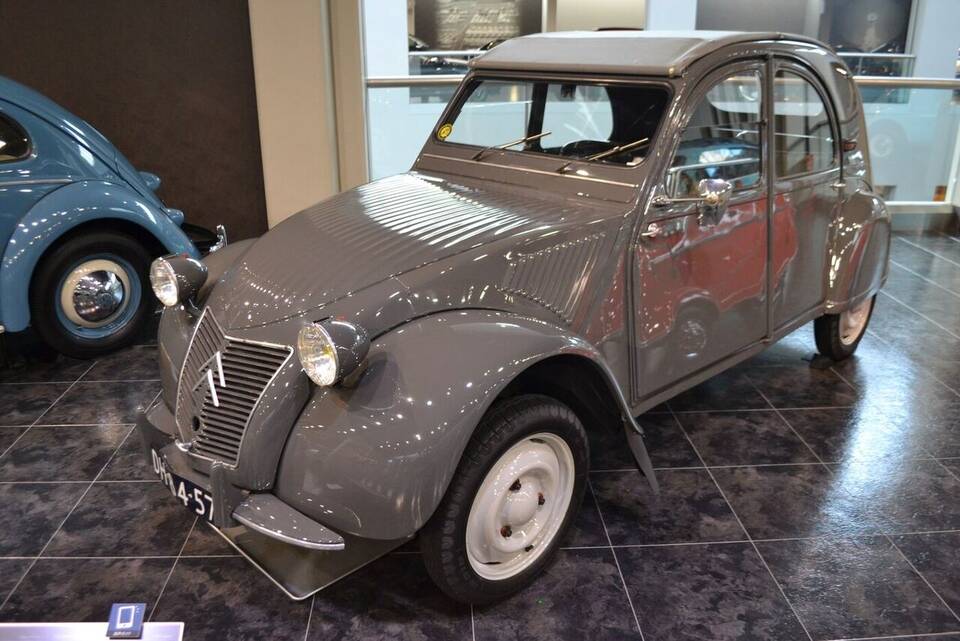
1948 Citroën 2CV Type A launch car · 先従隗始 · CC0
Research pending
A matching completed auction sale has not been verified for this exact year, body, trim, engine, transmission and market.
Joyride shows this gap instead of substituting an asking price, unsold bid or mismatched special vehicle.
More than a set of wheels.
The 2CV grew from the prewar Toute Petite Voiture project, a plan to give working families and farmers a practical, economical car. War canceled the 1939 show, but Citroën returned on October 7, 1948 with a thoroughly revised 2CV. Its soft suspension, roll-back roof, removable benches and air-cooled engine turned simplicity into a clever system rather than a punishment.
Look a little closer.
Citroën's design brief famously asked for a car gentle enough to carry eggs across a ploughed field without breaking them.
Photos show an example of the model or generation. The pictured vehicle’s year, equipment, or modifications can differ from the specification described here.
A 1948 debut and a 1949 production car
Citroën unveiled the 2CV at the Paris Motor Show on October 7, 1948, but the official 75th-anniversary history says production started in July 1949. That makes '1948 Type A' a launch identity, not a claim that customer production filled all of 1948.
Source: Citroën/Stellantis · 75 years of the 2CV ↗The 1948 display cars were not finished customer cars
A Citroën retrospective says all three cars displayed in Paris in 1948 lacked engines because the planned mechanical starting system had been dropped while electric starting was still unfinished. Citroën showed the 375 cc air-cooled engine and four-speed transmission at the following year's Salon. This is attributed manufacturer history, and it is another reason to separate the 1948 presentation from the later early-production cars used for mechanical photographs and the interactive cabin.
Source: Citroën/Stellantis Spain · the two Paris presentations ↗Comfort from simple moving parts
Four-wheel independent suspension and a low flat-twin helped the 2CV stay composed on rough roads, even though its body leaned dramatically in corners. Citroën Origins records the launch-family dimensions and 500 kg curb weight, while the anniversary release explains the bolt-on steel body and roll-back vinyl roof.
Source: Citroën Origins · 2CV collection record ↗The early cabin reduced driving to essentials
A rights-reviewed photograph of a documented 1951 2CV A shows the early Type A family's sparse driver station: a separate speedometer pod, exposed steering column, simple switch panel and almost no decorative trim. It is useful period-adjacent cabin evidence, but Joyride does not claim every photographed control was unchanged from the October 1948 Paris show car.
Source: Wikimedia Commons · documented 1951 Citroën 2CV A dashboard ↗What the early Type A gallery can—and cannot—show
The expanded gallery follows the 2CV A from a documented 1950 auction-display car through 1950s museum and period-use photographs. Those views clarify the corrugated bonnet, separate headlamps, narrow wheels, long fabric roof and remarkably spare body. They do not establish that every control, fastener, finish or restoration detail matches the October 1948 Paris Salon display; each later car remains labeled as related production context.
Source: Wikimedia Commons · Citroën 2CV A (1949–1962) ↗The brief began with jobs, not styling
Citroën started the TPV project in 1936 to give lower-income drivers a useful, economical car. The official brief asked for room for people and farm loads, 60 km/h performance and roughly 3 L/100 km economy; comfort mattered because a basket of eggs was supposed to survive a ploughed field. That is why the future 2CV's odd-looking features fit together. Long-travel suspension protected passengers and cargo, low weight helped economy, removable furniture made the cabin more useful, and front-wheel drive left the body free of a rear propeller shaft. The brief was not a literal promise that every 1948 car always achieved every target, but it explains the engineering priorities better than calling the car merely cheap.
Source: Citroen/Stellantis · 2CV history and engineering ↗A tiny prototype survived a huge interruption
Citroën's 75th-anniversary archive dates the TPV project to 1936 and the first roadworthy prototype to 1937. That early machine weighed about 370 kg, used one headlamp because contemporary rules allowed it, and was intended to carry four people plus 50 kg of luggage at up to 31 mph. Citroën prepared 250 pre-production cars for the cancelled 1939 Paris show. Most were destroyed after war began; the archive says four were secretly preserved at La Ferté-Vidame. Those figures describe the prewar TPV, not the heavier 500 kg postwar Type A. The distinction matters: the 1948 2CV kept the same human-centred mission while changing the actual car substantially.
Source: Citroen/Stellantis · 75 years of the 2CV ↗The launch car and the customer car are two dates
Pierre Boulanger presented the postwar 2CV at the Paris Motor Show on October 7, 1948. Series production did not start until July 1949, when the official anniversary record describes a 375 cc air-cooled flat-twin making 9 bhp and a 31 mph top speed. Joyride should therefore keep calling this page a 1948 launch specification rather than an ordinary 1948 model-year production car. Citroën's own later national histories sometimes round the early maximum to about 70 km/h, so the more specific 31 mph claim should stay tied to the July 1949 production description instead of pretending the official sources agree perfectly.
Source: Citroen/Stellantis · 75 years of the 2CV ↗Its suspension used more than soft springs
Citroën Origins lists four independent wheels, one inertia damper at each wheel and four friction dampers for the early specification. In plain language, the wheels could rise and fall separately while simple mechanical devices controlled bouncing. That helps explain the famous soft ride and dramatic body lean without reducing the story to a single magic spring. It also makes the egg-basket challenge technically meaningful: wheel travel and damping let the tyres follow rough ground while the body moved more gently. The exact spring layout is visible in specialist cutaways, but this profile should only claim the damper arrangement that Citroën's own collection record states.
Source: Citroen Origins · 2CV collection record ↗A body designed to be assembled and repaired
The early 2CV's four-door steel body was not a modern unitary shell. Citroën's historical dossier says the body and most bolt-on parts were attached to a box-section frame, while a roll-back vinyl roof replaced a heavy fixed steel panel. The design saved material and simplified manufacture, and removable benches made the same small car useful for people or cargo. Low-mounted masses — the flat engine and fuel tank — helped keep the centre of gravity down even though the tall, softly sprung body leaned visibly in corners. The official account describes rollover as almost impossible, but Joyride should phrase that as Citroën's historical claim rather than a modern safety-test result.
Source: Citroen/Stellantis · 2CV body and chassis history ↗Small tyres were part of the system
Citroën Origins specifies Michelin Pilote 125 x 400 tyres with inner tubes for its early collection car. Their narrow tread suited a light vehicle and kept steering effort and rolling resistance modest, while the large overall diameter helped the wheels cross ruts. They worked with the independent suspension rather than acting as a separate trick. The tyre size is useful exact-profile detail because it turns a vague description such as 'skinny wheels' into a checkable measurement; it should not be generalized to every one of the 2CV's many later versions.
Source: Citroen Origins · 2CV collection record ↗Scarcity made the waiting list longer than the car
The launch succeeded before Citroën could build enough cars. The official Austrian history says raw-material shortages kept early output low and waiting lists briefly stretched to as much as six years. Low purchase cost, a favourable two-tax-horsepower class and simple maintenance still made the 2CV attractive to the working families and rural users it was created for. This is an important post-launch consequence, not a specification: it shows that the austere design answered real demand in a country recovering from war rather than becoming famous only as a later nostalgia object.
Source: Citroen/Stellantis · 2CV history and engineering ↗The family total must stay separate from the launch car
Citroën's 2023 anniversary release counts 5,114,969 2CV-family vehicles, including 1,246,335 vans, before the last car left Mangualde, Portugal, at 4 p.m. on July 27, 1990. Citroën Origins separately lists 3,867,932 passenger cars, while an older national history gives 3,872,583. Those are whole-career totals, not production figures for the 1948 launch specification, and the passenger-car counts conflict by 4,651. Joyride can report the inclusive family total and van subtotal confidently while preserving the disagreement instead of manufacturing a false single passenger-car number.
Source: Citroen/Stellantis · 75 years of the 2CV ↗The 2CV was shaped in Paris and proved outside it
Citroen's 75th-anniversary archive places two different stages of the project in two different places. The design office was on Rue du Theatre in Paris, while development was fine-tuned at the La Ferte-Vidame test centre in Eure-et-Loir. That split fits the car's mission: engineers could design an extremely simple package on paper, but rough-road comfort, durability and load carrying had to be proved away from the drawing board. La Ferte-Vidame is also where Citroen says four prewar TPV prototypes were secretly stored after the other 1939 cars were destroyed. This is project geography, not proof that every launch-car component was finalized or manufactured at either site.
Source: Citroen/Stellantis · 75 years of the 2CV ↗A 1950 car can be a close visual guide without becoming the 1948 show car
Citroen's anniversary release identifies a 1950 2CV A Berline in its collection as identical to the car Pierre Boulanger unveiled when the 1948 Paris Motor Show opened. Citroen Origins uses that 1950 car for an official interactive presentation with a 72-frame exterior spin and cabin panorama. Together, those records make the viewer a much closer representation than a late 1986 Charleston model. The label still matters: this is a manufacturer-hosted view of a 1950 production example, not the physical 1948 display car, and the page does not prove that every fastener, finish or restored detail matches the launch day. Joyride should link it as representative early-Type-A evidence rather than as an exact digital twin.
Source: Citroen Origins · official 1950 2CV viewer ↗The family branched quickly, so later improvements need their own labels
The launch profile should not absorb every feature that later made the 2CV family famous. Citroen dates the box-bodied 2CV AU van to 1951, and the 2CV AZ to 1954 with a 12 bhp engine and centrifugal clutch. Those changes are useful navigation markers because they show the family already dividing into different bodies and mechanical specifications within six years of the unveiling. The 1948 launch page therefore keeps its 375 cc, 9 bhp identity; a photograph, recording or model of an AU, AZ, 2CV6 or Charleston can provide clearly labeled family context but cannot silently change the launch car's engine, body, clutch or model year.
Source: Citroen/Stellantis · 75 years of the 2CV ↗Front-wheel drive was part of the packaging idea
Citroen Origins calls the 2CV the world's first small front-wheel-drive saloon and separately lists four independent wheels. The front-drive layout was more than a line in the specification table: with the engine and driven wheels at the same end, the cabin did not need a propeller shaft running to a rear axle. That helped preserve a flat, useful interior in a very small car. The historical first is a manufacturer claim and should stay attributed to Citroen, but the packaging explanation is straightforward. For a young reader, the engine pulls the front wheels while the rear wheels simply follow, leaving more of the middle of the car available for people and cargo.
Source: Citroen Origins · 2CV collection record ↗Where these facts come from
- Citroën/Stellantis · 75 years of the 2CV
- Citroën Origins · 2CV collection record
- Citroën/Stellantis · 2CV history and engineering
- Citroën/Stellantis · 2CV as a symbol of freedom
- Wikimedia Commons · 1936 Citroen TPV at Musee Henri Malartre
- Netherlands Institute for Sound and Vision · Citroen 2CV arrives and stops
- Citroen Origins · official 1950 2CV viewer
- Citroën/Stellantis Spain · the two Paris presentations
Selected facts checked for this edition. Some source pages link to broader model families. Last reviewed October 5, 2026.