
Choose your next drive.
Choose a year and version. Each accepted vehicle has its own performance calibration.
67 vehicles available · cars and accepted motorcycles.
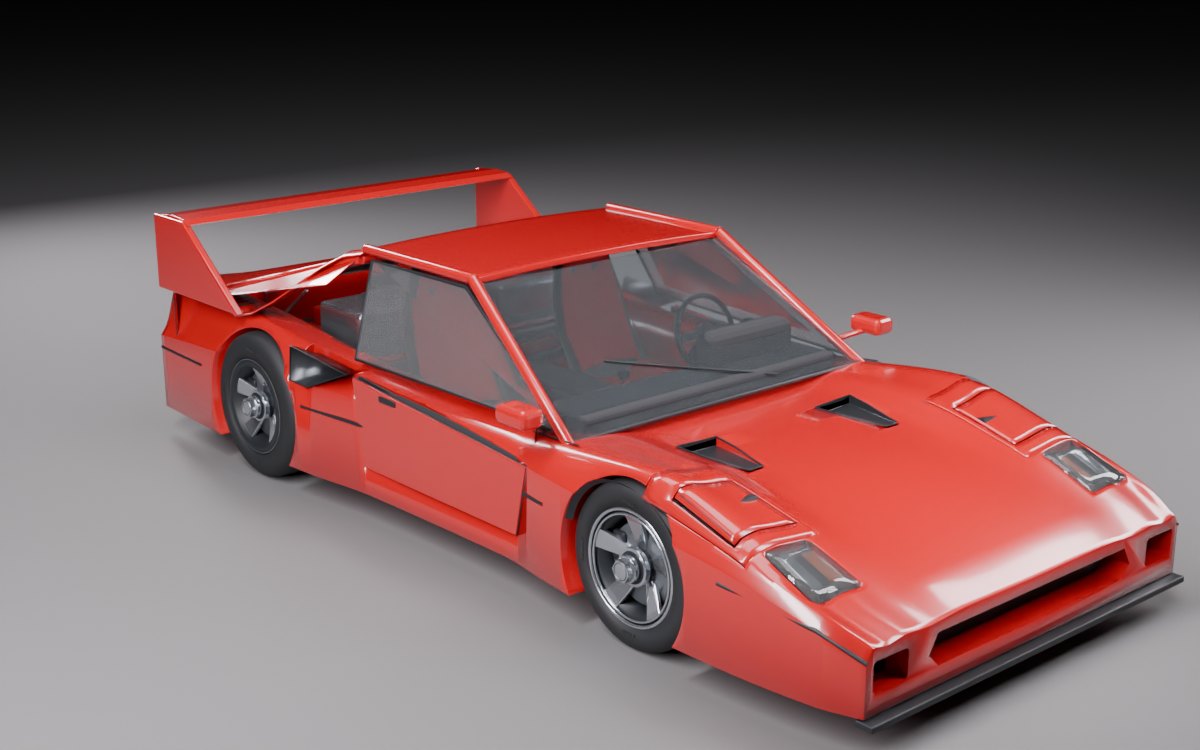
1987 Ferrari F40
European launch · 2.9 L twin-turbo V8 · five-speed manual
Keyboard: W/↑ throttle · S/↓/Space brake & reverse · A/D or ←/→ steer · C camera · P/Esc pause · T retry lap · R reset session
Performance, model and recording sources
Ferrari historical claims: 351.5 kW at 7,000 rpm, 324 km/h and 0–100 km/h in 4.1 s. Simulation mass is an estimated 1,250 kg running mass; Ferrari's quoted 1,100 kg is not treated as measured running weight. Braking uses an unverified 0.95 g estimate. Ferrari F40 historical specifications · Performance source
| Measure | Target | Simulation |
|---|---|---|
| 0–100.0 km/h | 4.1 s | 4.10 s |
| Top speed | 324.0 km/h | 324.0 km/h |
| 100.0 km/h–0 braking | Estimate; no verified target | 41.4 m |
Power, mass, rolling resistance and aerodynamic drag govern acceleration. Launch force is calibrated to the stated target. Efficiency, gear bands, grip and torque delivery remain approximations; full engine curves, turbo response, tyre behaviour, fade and weather are still in development. Matching these straight-line targets does not validate complete vehicle dynamics. The tight practice oval cannot demonstrate maximum speed.
3D model: Joyride · original procedural geometry · Source · Joyride original work. Pass 105 adds tapered fixed-lamp openings, four-ring recessed returns and curved inner carriers. The 240/220 mm opening widths, 245 mm length, 18 mm chamfers and 30 mm return depths are photographic/form estimates, not factory sections or calibrated measurements. Two cloud exports are byte-identical and the saved-master dimensional scaffold passed; lamp/arch surface continuity, canopy shape and materials remain unfinished WIP. Pass 45 retains the pass-44 closed sill/jamb/dashboard studies while replacing each flat inner-door card with a closed five-section shell and relief, adding dashboard lower-edge ribbons and refining the sill highlight crown. Later European-road-car photographs support the broad exposed sill/tub and sparse-door relationships, while Eurospares diagrams 111 and 118 support door/dashboard/tunnel component relationships; the 1.24 m visible sill length, 52 mm seat clearance, 18 mm inner-door shell, 7 mm relief, 6 mm crown, sections, weave, laminate and mount coordinates remain photographic/form estimates rather than 1987 factory measurements. Pass 47 exposes existing saved-master-checked portrait speedometer and tachometer cameras in the guided tour without changing geometry. Pass 48 adds a separate warning-lamp evidence stop: Ferrari road-car parts 134918 and 134453 support oil-pressure and coolant functions, while their vertical placement is only later-European photographic context, not exact 1987 launch proof. Pass 49 preserves independently named speedometer and tachometer needle roots and adds reusable bounded meter controls for 0–360 km/h and 0–10,000 rpm visual-sweep demonstrations. Pass 51 maps those roots in the practice driving game to explicitly scoped simulated speed and engine RPM with matching units, bounded face ranges and the pass-50 display damping. Pass 54 exposes the already checked wide-gauge camera as an optional live driving view through the generic camera contract. The framing, scale artwork and linear 270-degree sweeps remain source-informed visual estimates; game values are not live vehicle telemetry, sensor calibration, accuracy evidence, measured inertia or an engine-limiter claim. Pass 43 retains two original closed seat shells, continuous pads and cushions, qualified shoulder-pass-through cues and diagram-116-informed rail relationships. Wheel pass 39 retains original raised-rubber Pirelli, P Zero and axle-size text. Headlamp passes 33–41 retain physical-depth assemblies, true apertures, qualified closure surrounds and the full clearance sweep. Main dimensions, wheelbase, tracks and the 1.124 m roof top are checked; other local surfaces, gaps, glazing, lighting and cabin packaging remain estimates. Stable front-steer, four wheel-roll, steering-wheel and main-needle roots preserve browser/driving bindings. No front-cover articulation or accepted authentic stock-road-car/horn sound yet. Browser/device use is not verified on a physical mobile device.
Related V8 recording · Porsche Cayenne; authentic F40 sound is still in development. Recorded by Soundholder. Pitch and HUD RPM use approximate automatic gear bands. Recording source · License.
Drive clockwise. Boundary and steering assists keep this practice course approachable. Halfway and finish results stay in this session. Retry lap preserves session bests; Respawn resets them. A separate device best is private to this browser and is versioned by the exact vehicle, course geometry, handling setup and simulation step; changing vehicles loads that vehicle’s own record, while blocked or cleared browser storage simply disables it. The start lights and launch response are game feedback. The cabin study camera is provisional. The live gauge view reuses an authored inspection camera; framing, face calibration and simulated needle response remain provisional. Named steering and wheel roots move from the arcade state; their visual angles and steering relationship are estimated. A physical-device review is still in development.